Zen and the Art of Motorcycle Maintenance
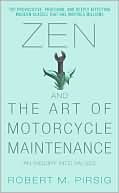
This book is linked with the post “Book Reviews!”.
Tags: Fiction, Philosophy, Zen
-
Started reading:
January 4, 2008
-
Finished reading:
January 2, 2009
Review
It took me almost a year to read “Zen and the Art of Motorcycle Maintenance”, and I could fill up many, MANY paragraphs about what I did and didn’t like about the book. But life is short, so I won’t. Truth is, there are sections that I could easily rate a 9 or 10, and other parts that I’d be hard-pressed to dole out anything other than a 2 or 3. Problem is, I don’t know if that’s a reflection on the book or on me.
See, a good 65-70% of Pirsig’s manifesto on Quality is an in-depth dissection and/or explanation of the intricate workings of different schools of Philosophy. And while it may or may not be accurate (how would I know?) much of it was WAAAAYYY over my head — or perhaps under it; after all… What IS up? What’s down? Left? Right? After reading “Zen and the Art of Motorcycle Maintenance” I can’t say that I really know. Of course, I don’t know much about anything to begin with, and while I didn’t quite find the meaning of life inside these pages, I did find some interesting nuggets to chew on. For example…
“You are never dedicated to something you have complete confidence in. No one is fanatically shouting that the sun is going to rise tomorrow. They KNOW it’s going to rise tomorrow. When people are fanatically dedicated to political or religious faiths or any other kinds of dogmas or goals, it’s always because these dogmas or goals are in doubt.”
After sitting with this for awhile, it seems quite obvious, but when I first read it, this seemingly simple little idea knocked me over the head with such force that I just sat in awe at the profundity of it. Of course, the PROBLEM (or perhaps, intended IRONY) with this book is that Pirsig spends several hundred pages “shouting” about Quality. And while much of it sounds or even SEEMS important, it’s at once evident that he’s whittling away at some idea in which he WANTS, but is unable to have complete confidence. And isn’t that sort of what makes Philosophy, well… PHILOSOPHY? If any of us had complete confidence in our individual belief systems, they would cease to be personal philosophies, and enter into the realm of undeniable TRUTH. Which is, of course, what most of us are seeking, but very few ever find. And while it’s unclear whether or not Pirsig’s protagonist THINKS he’s found this truth, it’s obvious that Pirsig himself is still looking — which is not a bad thing, but in this almost autobiographical journey, it undermines the effectiveness of the argument.
This is a book which, I suppose, should be required reading for any student of Philosophy (and aren’t we all to some extent?), but be forewarned that the road is neither easy, nor particularly FUN. In that regard, it’s kind of like life. And much like the chautauqua is a metaphor for the narrator’s struggle to find meaning, it’s hard to deny that the reading of this tome is like a big metaphor for the road we’re ALL on: seemingly endless, but over before you know it.